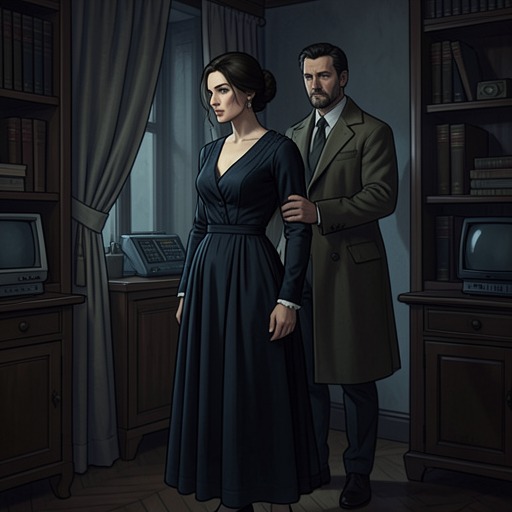
Beryl Stapleton warns Watson to leave the moor
The Hound of the BaskervillesBeryl Stapleton’s warning to Dr. Watson turns an encounter on the moor into an urgent but unresolved appeal to leave. She first commands him to return to London and never set foot on the moor again; when she catches him on his way back to Baskerville Hall, she says she had mistaken him for Sir Henry and explains her fear through the Baskerville curse and the hound legend. Her insistence is intense, but her knowledge remains uncertain, leaving Watson more alert to danger without giving him proof of what it is.
The warning on the moor
The encounter begins with Stapleton pursuing a small moth or fly across the treacherous mire. His sudden, energetic movement draws Dr. Watson’s attention away from the path and toward the danger of the ground itself: Stapleton leaps from tuft to tuft, his green net waving as he follows the insect. While Watson watches, Beryl Stapleton approaches from the direction of Merripit House. The scene places the warning amid the moor’s uncertain footing and shifting sightlines, rather than inside a controlled conversation.
Watson recognizes her as the woman he has heard described as a beauty. Her dark, elegant appearance sharply contrasts with Stapleton’s fair coloring, and her eyes are on her brother before she hurries toward Watson. She does not begin with an explanation or a greeting. Instead, she tells him to go straight back to London immediately. When he asks why, she says she cannot explain, but implores him to do as she asks and never return to the moor. Her low, eager voice and impatient gesture make the warning feel like an emergency whose grounds she cannot safely or clearly state.
She presses him to leave that very night and get away at all costs, then breaks off because her brother is coming. To cover the exchange, she asks Watson to fetch an orchid from among the mares-tails. The request changes the scene’s outward appearance from a private warning to an ordinary conversation about the moor’s flowers. Stapleton returns flushed and breathing hard after his pursuit, greeting her in a manner Watson finds less than cordial. The warning has therefore been delivered in secret, but its concealment is itself conspicuous.
A second encounter and a changed explanation
Watson refuses Stapleton’s pressure to stay for lunch. His thoughts are already burdened by the melancholy of the moor, the death of a pony, and the strange sound associated with the Baskerville legend; Beryl’s earnest warning adds a distinct and personal cause for concern. He cannot believe that she spoke without some grave reason, and he sets off along the grass-grown path toward Baskerville Hall.
Before he reaches the road, he is surprised to find Beryl sitting on a rock beside the track. She has run to intercept him, is flushed from the exertion, and has not even had time to put on her hat. This second meeting reverses the first one’s movement: there she hurried toward him before Stapleton could interrupt; now she has followed Watson along a shortcut and risks being missed by her brother. She apologizes for what she calls a foolish mistake: she had thought Watson was Sir Henry. She asks him to forget the warning because, as first delivered, it did not apply to him.
Watson refuses to treat the correction as sufficient. As Sir Henry’s friend, he says, he is concerned for Sir Henry’s welfare, and he asks why Beryl wanted Sir Henry to return to London. She calls it a woman’s whim and says she cannot always give reasons for her actions. Watson instead recalls the intensity in her voice and eyes, and describes his own sense of being surrounded by shadows since arriving. He likens life to the Grimpen Mire, where green patches can conceal a place to sink and no guide marks the safe path. The comparison makes the episode’s uncertainty explicit: he sees indications of danger but lacks a reliable route from suspicion to knowledge.
The curse and the limits of her knowledge
Beryl then gives a more definite account of her general fear. She and her brother, she says, were deeply shocked by Sir Charles’s death and had known him intimately; his favorite walk crossed the moor to their house. Sir Charles had been deeply impressed by the curse said to hang over his family. After his death, Beryl says, she naturally feared that his expressed anxieties had some basis, and was distressed that another member of the family had come to live at Baskerville Hall. Her warning, in this account, was an attempt to caution Sir Henry about the danger she believed he might face.
But when Watson asks what the danger is, the explanation narrows rather than resolves. Beryl asks whether he knows the story of the hound. Watson does not believe in such a thing; she does. She urges him to use whatever influence he has with Sir Henry to remove him from a place she considers fatal to the family, but admits that she knows nothing definite and cannot provide specific information. The difference between belief and evidence is central to the exchange: her fear is sincere in its force, yet she cannot identify a concrete threat or substantiate the legend that shapes her interpretation.
Watson also questions why she concealed the first warning from Stapleton if it was only a general concern about the family curse. Beryl answers that her brother wants Baskerville Hall inhabited because he thinks its occupation benefits the poor people on the moor. He would be angry if he knew that she had said anything that might persuade Sir Henry to leave. She has, she says, done her duty and will say no more; she must return before Stapleton notices her absence or suspects that she has seen Watson. Her explanation adds a practical reason for secrecy, while leaving open why the disagreement with her brother matters so much to the warning.
Consequence and narrative significance
Beryl disappears among the scattered boulders, and Watson continues to Baskerville Hall with vague fears still filling his mind. The episode yields no verified account of a plot and no actionable description of a specific danger. Instead, it establishes a persistent gap between urgency and knowledge: Beryl’s first appeal sounds absolute, her second account attributes it to a family legend and fear for Sir Henry, and her final admission is that she has no definite facts.
The encounter also changes how Watson reads the people around him. The moor’s deceptive ground, the interrupted conversation, Beryl’s hurried return, and her wish to keep Stapleton from hearing her all make information feel as unstable as the landscape. Her mistaken identification of Watson explains why the warning was initially directed at him, but does not erase the concern behind it. By the time he reaches Baskerville Hall, he has no proof to pass on beyond Beryl’s words, yet he has been given a new reason to distrust the apparent calm surrounding Sir Henry’s arrival.